

Have you ever googled “KPIs for mission-driven organizations” and felt overwhelmed by the endless lists of financial and technology companies, each offering dozens of metrics and tools? You are not alone. KPIs, or Key Performance Indicators, are widely used in many industries and are now common in purpose-driven organizations. At their core, KPIs help you track the insights that bring clarity to your work.
First, understanding what KPIs are and their benefits is the first step toward using them intentionally. With the complexity and demands that your organization faces today, KPIs are a helpful guide that allows you to direct your limited time, energy, and resources where they will make the most impact.
What KPIs Are – And Are Not
A KPI is a measurable indicator that helps organizations assess whether their strategies, programs, and/or investments are advancing their key goals. Not every data point is a KPI, and not every metric tells you if you’re making progress. As an example, consider an organization that publishes blogs as a method of outreach.
- “We published three blogs this month.” This statement represents data about their activity. While it is factual and useful for internal tracking, it is not a KPI because it does not tell you whether the blogs are contributing to a broader goal, such as reaching a new audience or increasing website traction.
- “Our blogs reached 100 more people this month than last month.” This statement represents a KPI metric because it connects the activity, publishing blogs, to a result that reflects progress toward an outcome. Instead of tracking simple output, it shows change over time and provides insight into whether the organization’s efforts are producing any sort of measurable results.
Two distinctions help make KPIs easier to understand and use: leading vs. lagging and local vs. global.
Lagging vs. Leading
Leading and lagging KPIs serve different roles in helping mission-driven organizations understand their goals and performance. Lagging indicators show what has already happened. They help you review performance and understand past results. Typically, lagging indicators are easy to measure and identify, and they represent your overall performance at the end of a project or at the end of the year. Some examples include how much you’ve fundraised, how many people you’ve reached, and whether you achieved the big-picture goals you set at the beginning of the fiscal year.
On the other hand, leading indicators point out what might happen in the future. They help you spot trends and make changes before problems or opportunities arise. These types of indicators can be useful throughout the year and are often measured more frequently over time to show how you’re doing currently and whether you are on track to achieve your deliverables. Leading indicators include donor retention rates or pre-event RSVPs which will help predict future fundraising success or attendance.
Using both types together gives you a clearer view of where your organization stands and where it is headed. The most effective performance frameworks use both. Lagging KPIs confirm results and accountability, while leading KPIs guide learning, improvement, and future decision-making. Together, they help mission-driven organizations not only measure performance but continuously improve it.
Global vs. Local
KPIs can also be global or local indicators. Global KPIs reflect overall outcomes and help you see the big picture. They guide your organization toward the broader goals and outcomes you have set at the organizational level. For example, a global KPI might be the percentage of participants who achieve a program’s intended outcome.
Local KPIs focus on specific activities, processes, or short-term results that influence those larger outcomes. These indicators are often tracked more frequently; they help teams understand what is happening on the ground and where adjustments may be needed. In the case of a program’s intended outcome, a local KPI could be the percentage of participants who attend at least 90 percent of program sessions.
In practice, most organizations only need a small number of global KPIs supported by a limited set of local KPIs to explain what is driving results. Having a blend helps teams stay focused on current and future performance.
Real-World Application: Standardized Test Preparation
Consider this example of a purpose-driven organization that offers a standardized test preparation program for high school students and wants to evaluate how well their current program is working.
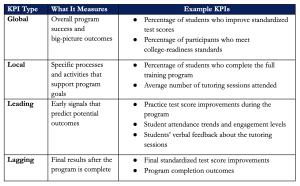
For example, the organization can use different types of KPIs to understand both overall success and day-to-day performance. By looking at global and local KPIs, along with leading and lagging indicators, the organization can assess whether students are achieving intended outcomes while also tracking progress throughout the program.
Why KPIs Matter for Purpose-Driven Work
Ultimately, KPIs allow mission-driven organizations understand all parts of their important daily work. Instead of guessing what is working in fundraising, programs, or communications, KPIs give you clear signals about where your efforts are paying off and where you might need to make changes. For busy teams with limited time and resources, KPIs reduce guesswork and help you make better decisions.
They also make it easier to share data about your progress with boards, funders, executives, and donors. Most importantly, KPIs give teams clarity during tough times so they can focus on the most important indicators to measure their work and impact. In our next blog, we will cover why there are so many types of KPIs and how to choose the right ones for your team.
Ready to Start Using KPIs to Evaluate?
If you are still unsure about how to choose the KPIs that are right for your organization, we can help. At Research Evaluation Consulting (REC), our goal is to strengthen organizations’ evaluation practices in ways that are clear, practical, and aligned with their capacity. Contact us to schedule a consultation and gain clarity through a thorough evaluation.
Sources
Booker, E. (2024). Top 25 Nonprofit KPIs to Measure Fundraising Success. Funraise.
Kinsey, S. (2024). 8 Non-Profit KPIs You Should Be Tracking and Why. SimpleKPI.
Kinsey, S. (2025). What Are Key Performance Indicators(KPIs)? SimpleKPI.
Matthias. (2025). High-Level vs. Low-Level KPIs: Understanding Performance Metrics. KPI.Zone.
Puutio, A. (2025). Nonprofits Face Double Crunch as Shutdown Follows Severe Funding Cuts. Forbes.
Salesforce. (n.d.). KPIs for Nonprofits. Salesforce.
Smith, A. (2022). Fundraisers’ Guide to Measuring and Reporting Nonprofit KPIs. Fundraising Kit.
Shtivelband, A. (2021). 6 Benefits of Evaluation. Research Evaluation Consulting.
Shtivelband, A. (2025). Effective Nonprofit Evaluation Plans. Research Evaluation Consulting.
Twin, A. (2025). KPIs: What Are Key Performance Indicators? Types and Examples. Investopedia.
Related Posts
6 Research Solutions to Strengthen Your Organization